A growing awareness exists in dentistry that digitally generated treatment planning may not always create fully predictable, accurate clinical outcomes. (Image: Viktorua/Adobe Stock)
Artificial intelligence (AI) continues to significantly transform digital dentistry. In aligner therapy, AI-driven systems now assist with tooth segmentation, treatment set-up proposals, movement staging, attachment placement and even predictions of treatment outcomes. For many clinicians, this development is both exciting and unsettling. On the one hand, AI has considerably improved efficiency in digital workflows. Treatment simulations can be generated within minutes, visualising tooth movement in ways that were unimaginable only a decade ago. On the other hand, a growing number of clinicians are encountering an uncomfortable reality: digital simulations that look perfect do not always translate into predictable clinical outcomes. Understanding why this happens is becoming increasingly important as aligner therapy continues to expand worldwide.
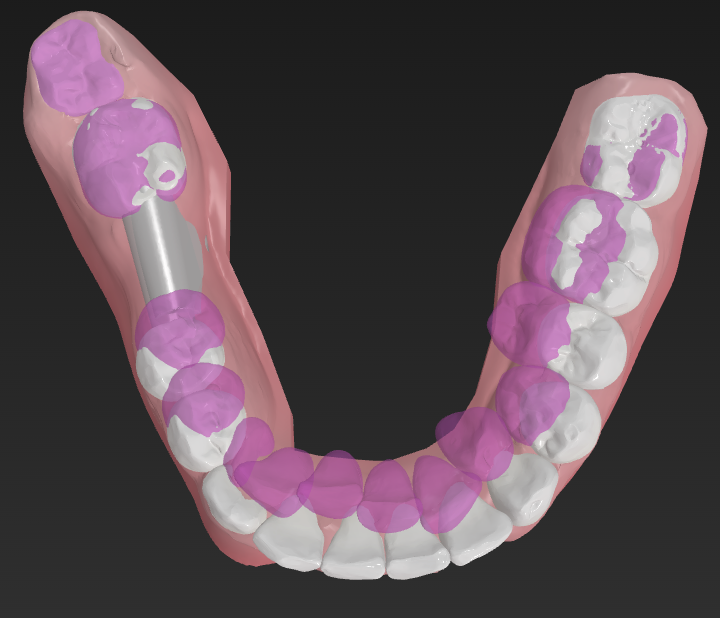
Overlay of the initial tooth position (purple) and the proposed digital treatment setup (white). In this case, the automated treatment proposal suggests movements that exceed realistic biological limits, illustrating why digital setups require careful clinical interpretation. (Image: Dr Jesper Hatt)
The moment many clinicians recognise
Many dentists who employ aligner therapy will recognise the following situation. A digital treatment set-up looks elegant. The animation shows teeth aligning smoothly, arch coordination improving and the occlusion appearing to settle ideally. Everything appears controlled and predictable. The clinician approves the plan.
During the first weeks of treatment, everything seems to progress as expected. But somewhere around the tenth or fifteenth aligner, something begins to change. A tooth stops tracking. Attachments fail to engage effectively. An anterior open bite develops.
Suddenly, refinements become necessary. At this point, many clinicians ask themselves a simple question: if the treatment was planned with advanced digital tools and AI, why did the clinical result not follow the simulation? The answer lies in understanding what AI can do well—and where its limitations begin.
When AI performs best
AI performs extremely well when the task is based on objective and measurable criteria. For example, AI systems have already demonstrated impressive accuracy in detecting caries on radiographs. In such cases, the question is relatively clear: is a lesion present or not? If so, how extensive is it?
These are classification tasks with defined parameters. AI systems are particularly good at recognising patterns in data. When the criteria are objective and binary, AI can often match or even exceed human performance. The same principle applies to some aspects of orthodontic diagnostics. Identifying deviations from defined occlusal relationships or anatomical norms can be approached computationally. However, the situation changes dramatically when we move from diagnosis to treatment planning.
“Digital simulations that look perfect do not always translate into predictable clinical outcomes.”
Treatment planning is not a binary problem
Orthodontic treatment planning rarely has a single correct answer. Consider a typical aligner case involving moderate crowding. Several treatment strategies may be possible:
Should the clinician expand the arch or perform interproximal reduction?
Should incisor alignment prioritise aesthetics or occlusal stability?
Should minor compromises be accepted in order to shorten treatment time?
These questions involve judgement and clinical philosophy. Even experienced clinicians may propose different solutions for the same case. AI cannot independently resolve these trade-offs in the way a clinician does. Instead, it identifies patterns within historical datasets and generates statistically optimised solutions. But statistical optimisation is not the same as clinical decision-making.
The data behind AI systems
Modern aligner systems are trained on enormous datasets drawn from previous treatments. At first glance, this seems like a major advantage. More data should mean more accurate predictions. However, the nature of the data matters as much as the quantity. Large aligner databases include cases treated by thousands of clinicians with very different experience levels, treatment philosophies and finishing standards. Some clinicians carefully review every treatment set-up. Others rely heavily on automated proposals.
As a result, the dataset from which AI learns may contain significant variation in quality and clinical strategy. AI does not evaluate these differences in the way clinicians do. It simply identifies patterns within the data it receives. If the underlying data reflects variation in clinical experience, treatment philosophy and finishing standards, the resulting recommendations may also reflect that inconsistency. This is one of the reasons why digital treatment set-ups should always be interpreted critically by the clinician.
When digital models meet biological reality
Another important limitation arises from the difference between digital models and biological systems. Aligner treatment planning begins with digital models created from intra-oral scans. Before tooth movement can be simulated, the software must determine where one tooth ends and the next begins. This process of tooth segmentation is partly based on estimation. In areas where the scan data is incomplete or ambiguous, the software must interpolate missing data or smooth the digital surface. Small assumptions made during this step can influence the virtual geometry of the teeth and therefore the predicted movement patterns.
While the digital model may appear mathematically precise, it is still an approximation of biological reality. Once the treatment simulation begins, additional layers of abstraction are introduced: movements are staged digitally, attachments are suggested automatically and collisions between teeth are calculated digitally. Each step contributes to the final animation that the clinician sees on screen. However, teeth do not move because an animation shows them moving; teeth move because forces are applied within biological limits. That distinction is critical.
The hidden role of biomechanics
One of the most under-estimated aspects of digital aligner planning is biomechanics. In many digital simulations, individual teeth can appear to move independently. A premolar is rotated. An incisor is intruded. The arch is expanded. In reality, orthodontic movement never occurs in isolation. Every force applied to a tooth produces reactive forces elsewhere in the system. Aligners distribute forces across the entire dentition. Anchorage must be managed carefully, and movement of one tooth inevitably affects others. When digital set-ups present movements as independent events, it can create the illusion that biomechanics are simpler than they actually are.
The clinical consequences often appear later during treatment. Anchorage may be lost unexpectedly, vertical control may be lost or teeth may fail to track as predicted. These are not necessarily failures of the software. They are expressions of biological and mechanical complexity.
“Statistical optimisation is not the same as clinical decision-making.”
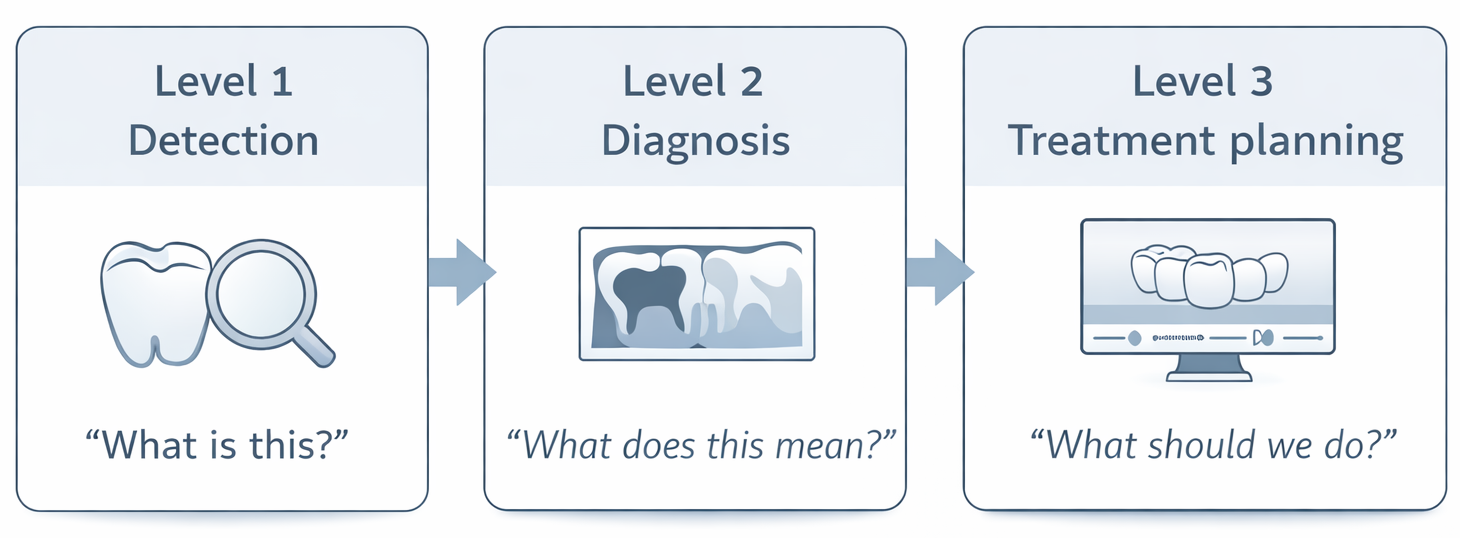
The ideal decision-making sequence within a digital dentistry workflow. (Image: Dr Jesper Hatt)
Maintaining clinical oversight
AI is undoubtedly a powerful tool in modern dentistry. Used appropriately, it can increase efficiency, aid diagnostics and streamline digital workflows. However, AI should support clinical decision-making rather than replace it. Before reviewing a digital treatment set-up, the clinician should already have a clear diagnostic understanding of the case and defined treatment objectives. Without this framework, the software itself may begin to guide the treatment plan.
The digital set-up should therefore be interpreted as a proposal rather than a final plan. Clinicians must evaluate whether the suggested movements are biomechanically realistic, whether anchorage requirements have been considered and whether the proposed outcome aligns with the treatment objectives. When clinicians maintain this critical perspective, digital tools become extremely valuable. They enhance efficiency while preserving clinical responsibility.
The future of AI in aligner orthodontics
AI will undoubtedly continue to improve. Future systems will likely incorporate larger datasets, more advanced biomechanical models and increasingly sophisticated predictive capabilities. These developments will further strengthen digital orthodontics, yet the fundamental role of the clinician will remain unchanged.
AI can identify patterns, support prediction and generate proposals. But it cannot replace clinical judgement, treatment philosophy or responsibility for patient outcomes. Those responsibilities will always belong to the treating dentist.
Take-home message
AI is an extraordinary tool in aligner orthodontics. It can increase efficiency, assist with digital workflows and support clinical decision-making. But AI does not replace clinical judgement. Digital treatment set-ups should always be interpreted critically, giving careful attention to diagnosis, biomechanics and treatment objectives. Efficiency without clinician-led decision-making risks turning treatment planning into automation. Efficiency combined with clinical oversight, however, can lead to more predictable and successful outcomes.
COPENHAGEN, Denmark: 3Shape has recently announced a series of new workflows in its laboratory software that are driven by artificial intelligence (AI). ...
In June, Dental Tribune International reported on an incisive study that explored the perspectives of dental patients on the ever-increasing role played by ...
HELSINKI, Finland: Aligners offer a straightforward and efficient orthodontic treatment option that can be used to achieve aesthetic and functional ...
COLOGNE, Germany: LM-Dental, one of the world’s leading manufacturers of ergonomic dental instruments, actively works with dental clinics to ensure its ...
MALMÖ, Sweden: New research conducted at Malmö University has found that radiation exposure from dental imaging can be reduced for paediatric patients ...
MALMÖ, Sweden: As a follow-up to last year’s clinical symposium, which was the first of its kind for TePe, the Swedish oral health company is hosting a ...
When I first heard about clear aligners in the early 2000s (the US Food and Drug Administration approved the use of clear aligners to straighten teeth in ...
HELSINKI, Finland: Finnish dental manufacturer Planmeca has announced the release of Romexis 7, the latest version of its all-in-one dental software. First ...
AARHUS, Denmark: As the implementation of artificial intelligence (AI) in the dental industry continues to accelerate, there appears to be a growing ...
Education
Live webinar Thursday, 2. April 2026 18:00 CET (Oslo)



 International / International
 Brazil / Brasil
 Canada / Canada
 Latin America / Latinoamérica
 USA / USA
 Austria / Österreich
 Bosnia and Herzegovina / Босна и Херцеговина
 Bulgaria / България
 Croatia / Hrvatska
 Czech Republic & Slovakia / Česká republika & Slovensko
 France / France
 Germany / Deutschland
 Greece / ΕΛΛΑΔΑ
 Hungary / Hungary
 Italy / Italia
 Netherlands / Nederland
 Poland / Polska
 Portugal / Portugal
 Romania & Moldova / România & Moldova
 Slovenia / Slovenija
 Serbia & Montenegro / Србија и Црна Гора
 Spain / España
 Switzerland / Schweiz
 Turkey / Türkiye
 UK & Ireland / UK & Ireland
 China / 中国
 India / भारत गणराज्य
 Pakistan / Pākistān
 Vietnam / Việt Nam
 ASEAN / ASEAN
 Israel / מְדִינַת יִשְׂרָאֵל
 Algeria, Morocco & Tunisia / الجزائر والمغرب وتونس
 Middle East / Middle East

 Dr. Shizuma ShibataLive webinar
 Dr. Matthias RzeznikRegister now1.5CELive webinar
 Dr. Mona PatelRegister now1CELive webinar

 Prof. Moritz Kebschull, Cat EdneyRegister now1CE







To post a reply please login or register